



Health Sharing vs. Health Insurance: 2026 Comparison
Health sharing and medical cost sharing are community-based alternatives to health insurance, where members contribute monthly funds to help cover each other’s eligible medical expenses.
Unlike insurance, these models are built on shared responsibility rather than corporate contracts—and for many, that shift leads to lower costs, greater transparency, and more flexibility in care.
If you’re comparing your options in 2026, here’s what you need to know.
What Is the Main Difference Between Medical Health Sharing and Health Insurance?
At a high level, the difference comes down to structure and philosophy.
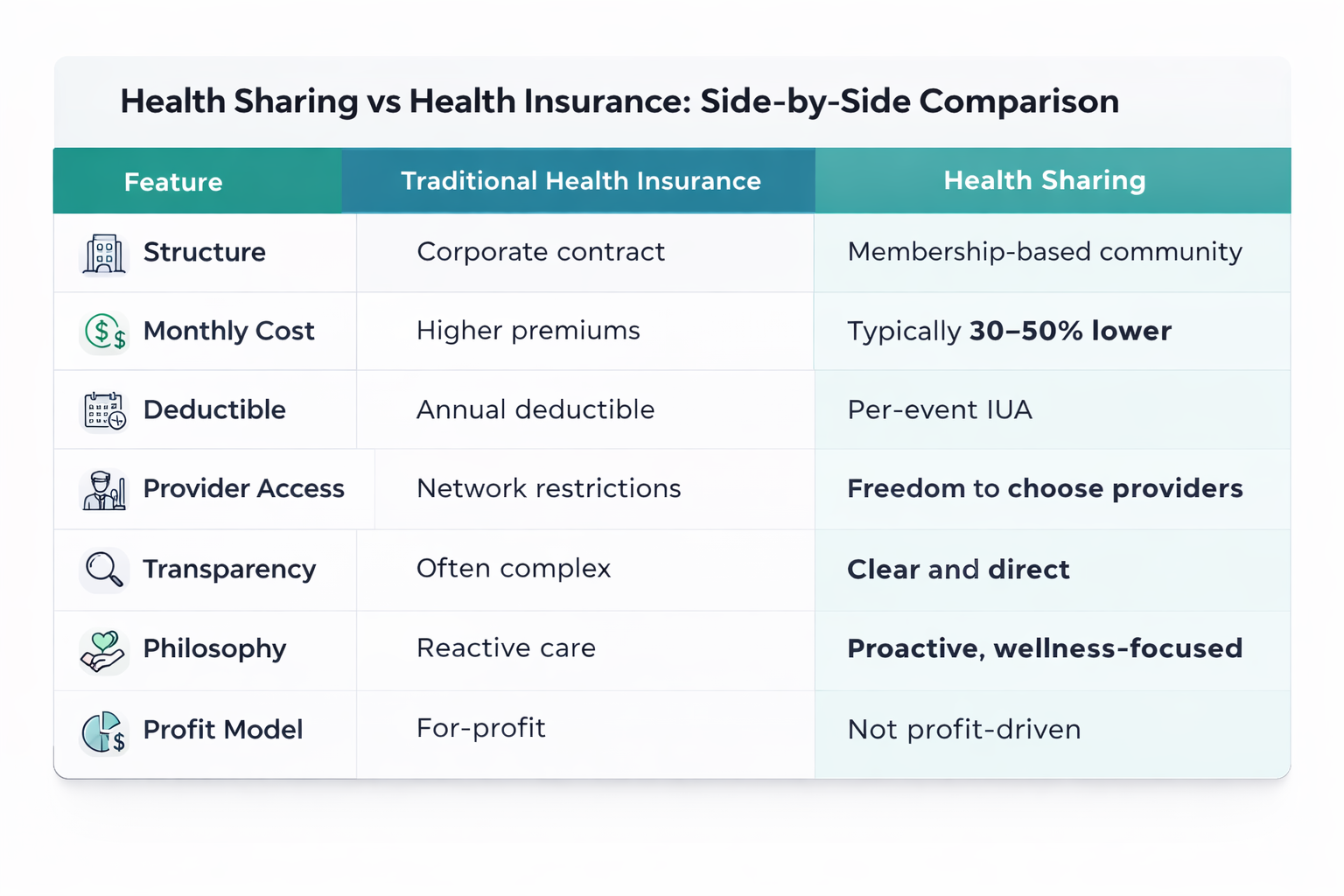
Health insurance is:
- A legally binding contract
- Managed by a corporation
- Designed to transfer financial risk
Medical Cost sharing is:
- A membership-based community
- Built on voluntary participation
- Designed around shared responsibility
At Knew Health, members contribute a monthly share that helps support eligible medical needs across the community—without the layers of insurance overhead.
While often grouped under the broader “health sharing” category, Knew Health operates as a medical cost sharing community, offering a more modern, flexible approach to how healthcare costs are shared.
If you want to understand the philosophy behind this model, you can learn more on our Services page.
Understanding how health sharing works in 2026
To understand how medical cost sharing works in practice, it helps to look at the mechanics of the Initial Unshareable Amount (IUA) and the monthly share.
In 2026, many individuals and families find that high-deductible insurance plans offer limited value for their cost. Medical cost sharing simplifies this by focusing on meaningful medical events, while reducing administrative complexity.
Here is how the process typically works within a health sharing community:
- Monthly Contributions : Members pay a set amount each month based on their age and family size.
- The IUA : When a medical event occurs, the member pays their IUA first (similar to a deductible but per event).
- Sharing Requests : Once the IUA is met, the remaining eligible bills are shared by the community funds.
- Negotiation Services : The community often helps negotiate lower rates with providers to stretch the community's dollars further.
- Wellness Focus : Membership often includes resources for annual exams, lab work, and everyday care.
For a deep dive into what is considered a sharable event, please review our guidelines.
Is Medical Cost Sharing Legit and Safe?
A common question when exploring an alternative to health insurance is whether medical cost sharing is legitimate.
The answer is yes—when you choose a transparent and well-managed organization.
Medical cost sharing communities have existed for decades and continue to evolve as more individuals look for flexible alternatives to insurance.
It’s important to understand that medical cost sharing is not insurance and does not provide a contractual guarantee of payment. Instead, it operates through a structured system of member contributions and established sharing guidelines.
Organizations like Knew Health prioritize transparency, responsible fund management, and member support to ensure the system operates with integrity.
Primary Advantages of Choosing a Medical Cost Sharing Community
Choosing a health share offers several perks that go beyond just the monthly price tag. In 2026, consumers are looking for more freedom and less bureaucracy in their medical care.
- Price Transparency: You know exactly where your money goes—to help people, not to corporate overhead.
- Provider Choice: Most health share memberships allow you to see any licensed doctor or specialist without being restricted to a narrow PPO or HMO network.
- Lower Costs: Members often save thousands of dollars annually compared to insurance premiums.
- Personalized Care: Without the constraints of insurance-mandated treatments, you and your doctor have more control over your healthcare journey.
- Community Values: You are part of a group that supports wellness and helps others in times of need.
- Preventative, Whole-Person Approach: Instead of waiting until something breaks, health sharing communities, especially Knew Health, support your health proactively through:
- Coaching and lifestyle guidance
- Preventive testing and lab access
- Wellness tools and supplement discounts
To see how much you could save by switching, use our Cost Calculator..
Who is the ideal candidate for a health sharing community?
Health sharing is an excellent alternative to health insurance for many, but it is not a one-size-fits-all solution. It is particularly effective for those who do not qualify for significant government subsidies (like those on the ACA exchange) and who find themselves paying full price for expensive private plans.
Ideally, health sharing is best for:
- Freelancers and Entrepreneurs: Those who do not have access to employer-sponsored coverage.
- Healthy Individuals and Families: People who prioritize wellness and don't have frequent, chronic medical needs.
- Small Business Owners: Employers looking for affordable ways to support their team's health.
- Early Retirees: Individuals who need healthcare until they qualify for Medicare.
If you have extensive pre-existing conditions that require ongoing, expensive specialty medications, insurance may still be your best financial bet due to ACA protections. However, for the majority of healthy Americans, the health sharing model provides a superior balance of cost and care.
Practical comparison: Medical Cost sharing vs. Health Insurance

Frequently Asked Questions about Health Sharing
Is health sharing ACA compliant? Health sharing is not insurance, so it does not meet the technical definition of ACA-compliant insurance. However, the federal individual mandate penalty was reduced to zero in 2019, meaning there is no longer a federal tax penalty for choosing medical cost sharing over insurance.
How are pre-existing conditions handled? Most health share memberships have a waiting period or specific limitations for pre-existing conditions to protect the community’s financial health. It is vital to check the guidelines for specific look-back periods.
Can I use medical cost sharing for emergency room visits? Yes. True emergencies are generally eligible for sharing once the member meets their Initial Unshareable Amount (IUA).
Final Takeaways on Medical Cost Sharing in 2026
Choosing between medical cost sharing and health insurance comes down to your financial priorities, healthcare preferences, and how you want to engage with your health.
While insurance offers a structured, contract-based plan, medical cost sharing provides a more flexible, community-driven alternative designed around transparency and personal responsibility.
For many individuals and families, it represents not just a cost-saving decision—but a shift toward a more proactive and supported healthcare experience.
- Health sharing typically costs 40-50% less than health insurance.
- Members enjoy total freedom to choose their own doctors and specialists.
- The model is best suited for healthy individuals, families, and the self-employed.
- Reputable organizations use IUAs to manage large medical events effectively.
Ready to take the next step in your healthcare journey? Sign up and join our growing community of wellness-focused members.